
Home
Preamble
Index
Areas
Dales
Hills
Lakes
Places
Reserves
Rivers
Structures
Villages
References
Me
Saunterings: Walking in North-West England
Saunterings is a set of reflections based upon walks around the counties of Cumbria, Lancashire and
North Yorkshire in North-West England
(as defined in the Preamble).
Here is a list of all Saunterings so far.
Guaranteed ad-free, AI-free and free!
264. To a Bare Blue Hill … Beautiful, Dark and Solitary
This being Remembrance Week I thought I’d walk to Burton-in-Lonsdale.
And this being the first seriously frosty morning of the winter, I left
the car frozen in the drive and took the bus to Tunstall.
 Tunstall is a small village mainly known for its Lunesdale Arms. I
like the row of cottages opposite, one of which bears a “circa 1640” sign.
This is refreshingly honest – normally, the dates on old cottages
are unreasonably precise. It also says “The Old Post Office”, which
it wasn’t in circa 1640.
Further on I passed Marmaduke House with a plaque saying
“Sir Marmaduke Tunstall 1506-57”. Marmaduke was of the illustrious
Tunstall family of the nearby Thurland Castle but not, I think, the
most illustrious of that family. That honour lies with Thomas,
knighted at Agincourt, who was granted a royal licence to fortify the
site in 1402, or Cuthbert, who became Bishop of Durham from 1530 to
1559, or Brian, who was slain at the Battle of Flodden Field in 1513.
This Brian is the ‘stainless knight’ described in Scott’s Marmion:
“Tunstall lies dead upon the field, His life-blood stains the spotless
shield”. The Tunstalls sold the castle in 1605 but the village kept
their name.
 I was passed by a runner, with whom I agreed that it was a “grand morning”.
There was not a cloud in the sky and the sheep were contentedly nuzzling
the whitened grass. The runner shouted a “Where are you going?” but didn’t
pause for my reply. A few minutes later he ran back past me, which was odd.
Runners usually contrive a suitable loop rather than run to a point and then
turn back. Perhaps there was an explanation?
The track came to an end at a house called Beckside with a
large ‘private’ sign. I could find no footpath sign where a path is marked
on the map. Perhaps it was through a large puddle of indeterminate depth,
probably part of Cant Beck, to the right. It wasn’t through a field of
bullocks to the left. (Looking now more closely at the map, I think I had
missed the footpath leaving the track before reaching Beckside.)
I turned back to take a path south to Cantsfield
instead.
 Right: Cantsfield House (not quite symmetrical).
Again, I could find no footpath sign. I set off across a field where I
thought the path was but after ten minutes I paused. I had three miles
of this ahead. If I cannot find the footpath signs (if there are any)
then how would I find the stiles or whatever I need to get across these
fields? I did not anticipate anything much of interest within these
anonymous pastures. So I turned to walk back to the bus-stop. It was indeed
a grand morning but I felt that I had wasted an hour of it.
 I had intended to walk over fields to Burton-in-Lonsdale and then Ingleton.
I don’t give up easily so I set off to walk there on the road, the A687.
Ordinarily, this is a foolish thing to attempt. There are no pavements
by the road, which is busy and quite winding so that you cannot always
see approaching traffic (and vice versa). It is just about wide enough
for two cars but not for a pedestrian as well.
I walked on the right side of
the road to face oncoming traffic, ready to squeeze into the hedge at any
moment, watching out always for overtaking traffic from behind.
Unfortunately, the sun was low to my right which meant that the hedge kept
me in shadow. No doubt some drivers didn’t even see me, squeezed in the
hedge. I switched to walking on the sunny side of the road, relying on my
ears to warn me of traffic from behind. On the way I passed Halfway House
but it wasn’t halfway for me. Of course, this walk was no fun at all but,
perversely, it was an absorbing challenge to stay safe.

 Approaching Burton-in-Lonsdale I left the road and took a track up to
the Old Vicarage. Here there is in the porch a plaque which you cannot
read without walking up the drive to it. I did so you needn’t. It is not
one of those blue plaques but a flowery one, rather neglected and
bearing the name of Laurence Binyon.
Everybody has heard the words of Laurence Binyon, or at least one
verse of one of his poems:
They shall grow not old, as we that are left grow old;
Age shall not weary them, nor the years condemn.
At the going down of the sun and in the morning
We will remember them.
 The words are part of
For
the Fallen, which he wrote in
September 1914, just seven weeks into World War I. He, of course,
did not know how many millions his words would honour.
During World War II he wrote
The Burning
of the Leaves, considered
to be his masterpiece, about the London Blitz.
Laurence Binyon (1869-1943) was born in Lancaster, moving to
Burton-in-Lonsdale in 1870 when his father became vicar there, and
then moving to Chelmsford five years later.
His working career was with the British Museum, where he
became an authority on Oriental art.
His brief time in
Burton-in-Lonsdale did, however, make an impression upon him for
his first poem
Inheritance
describes his view of Ingleborough from the vicarage windows. The poem begins:
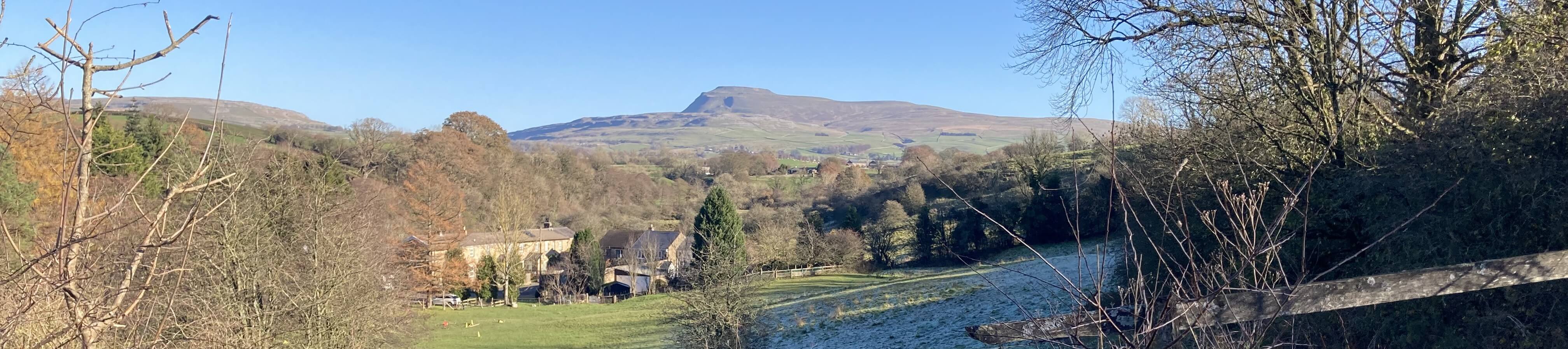 To a bare blue hill
Wings an old thought roaming,
At a random touch
Of memory homing.
The first of England
These eyes to fill
Was the lifted head
Of that proud hill
And ends:
They come over the mind
When the world’s noise is still
As to me comes the vision
Of one blue hill,
Beautiful, dark,
And solitary,
The first of England
That spoke to me.
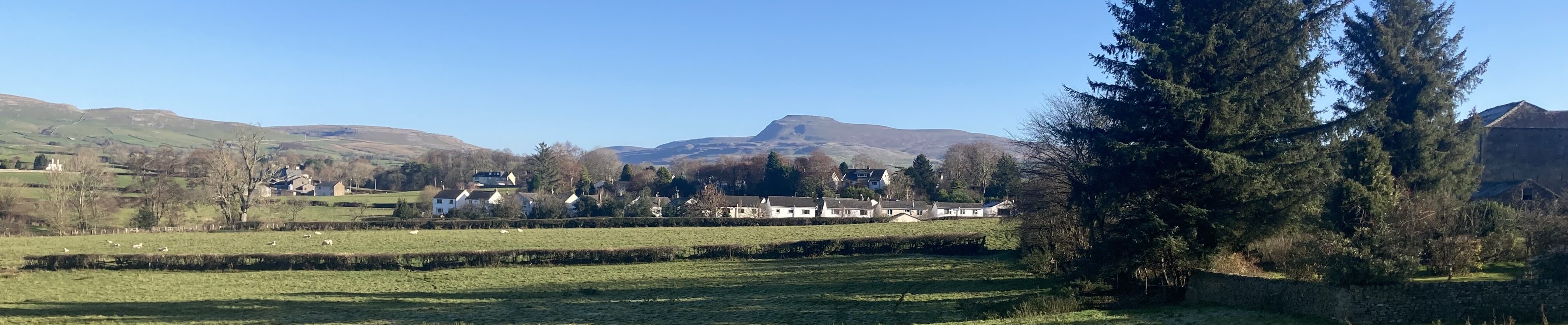
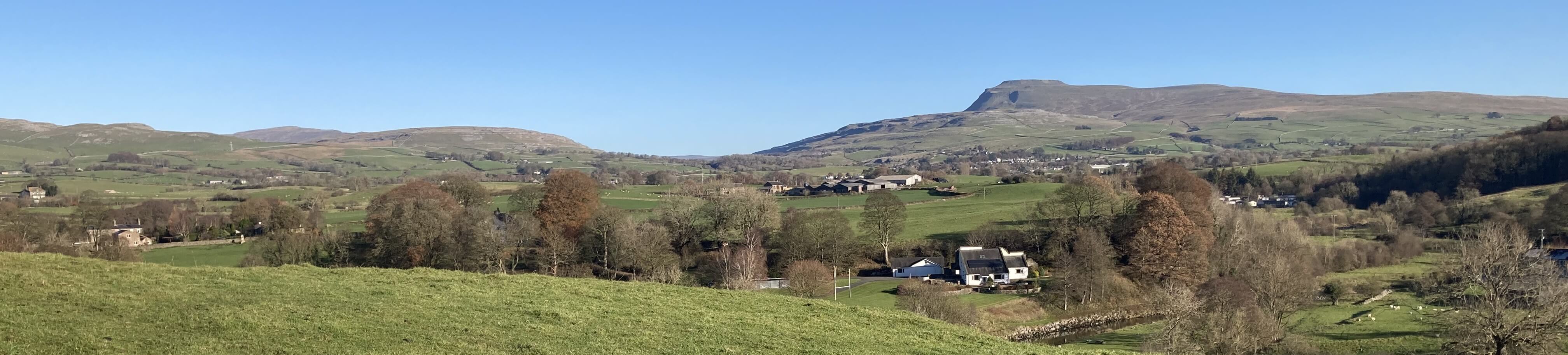 Ingleborough had been in view for me, intermittingly, all the way
from Tunstall and this did indeed feel like a walk towards that beautiful,
dark, and solitary hill. Ingleborough has become the central hill of
these Saunterings. Its distinctive profile can be seen from many of
the walks described here. While I cannot see Ingleborough from our
garden, it takes only a few hundred yards walk to bring it into view.
It oversees our valley and much else besides. Yes, like Binyon, I
feel a particular affection for this bare blue hill.
From the vicarage I walked down past a building that used to have
a large sign “Richard Thornton’s Church of England Primary School” but
is sadly now being demolished. Local-born Richard Thornton died in 1865
leaving a fortune amassed from his shipping business. This was used
to fund not only the school but the building of the church at which
Binyon’s father became vicar. The church is near the prominent
hump of the old motte and bailey castle and has a
steeple unusual
in this region.

 Detouring a little through Burton-in-Lonsdale, I walked along
Duke Street and Low Street, passing old cottages some of which have names indicating
their previous roles. By this stage, I was resigned to road-walking
but opted off the A687. Instead, I walked on quieter roads
to the south of the River Greta. There was now a pleasant
breeze and, the roads being higher, more extensive views.
It was a relatively enjoyable three miles to Ingleton,
although my feet were beginning to object. They may not have
walked so far on roads before - and I mean on roads, not
pavements beside a road.
It was with a sense of relief - and a satisfaction that I had made it
despite the initial problems - that I staggered into Ingleton.
At least I always had Ingleborough ahead to inspire me.

Ingleton and Ingleborough
Date: November 12th 2026
Start: SD607736, Tunstall bus-stop (Map: OL2)
Route: For information, not for following! (linear) NE –
Beckside – SW, S on path to Cantsfield for 10 minutes – N, SW – Tunstall bus stop –
S on A683 – Greta Bridge – E on A687 and track – Old Vicarage, Burton-in-Lonsdale – SE over bridge,
SE on Bentham Moor Road, NE on Bentham Road – Ingleton
Distance: 8.5 miles; Ascent: 150 metres
Home
Preamble
Index
Areas
Dales
Hills
Lakes
Places
Reserves
Rivers
Structures
Villages
References
Me
© John Self, 2018-
Contact: johnselfdrakkar@gmail.com

Top photo: Rainbow over Kisdon in Swaledale;
Bottom photo: Ullswater