
Home
Preamble
Index
Areas
Dales
Hills
Lakes
Places
Reserves
Rivers
Structures
Villages
References
Me
Saunterings: Walking in North-West England
Saunterings is a set of reflections based upon walks around the counties of Cumbria, Lancashire and
North Yorkshire in North-West England
(as defined in the Preamble).
Here is a list of all Saunterings so far.
Guaranteed ad-free, AI-free and free!
If you'd like to give a comment, correction or update (all are very welcome) or to
be notified by email when a new item is posted - please send an email to johnselfdrakkar@gmail.com.
244. The Art Deco of Morecambe
Speaking of buses (as I was in the last Sauntering [243]), our
village has recently been given a new bus service (there’s a novelty), to take us to
Morecambe. I felt it my duty to use it before the bus company accepts that there really
aren’t that many villagers longing to travel to Morecambe.
 After my unexpectedly tiring walk on the Ingleton Waterfalls Trail I thought
I’d stroll around Morecambe, studying its architectural gems. Yes, I’m sure there are
some – well, one at least. I made a bee-line for the Midland Hotel, of course.
After my unexpectedly tiring walk on the Ingleton Waterfalls Trail I thought
I’d stroll around Morecambe, studying its architectural gems. Yes, I’m sure there are
some – well, one at least. I made a bee-line for the Midland Hotel, of course.
 The Midland Hotel is the most impressive Art Deco building in north-west England,
invariably listed among the best Art Deco buildings in the country. What is Art Deco? Well,
architecture is one of the many subjects that I have in these pages to pretend that
I know something about. I can always write “the most impressive Art Deco building” knowing
that readers cannot interrogate me to find out that I have little idea what Art Deco means.
On this occasion, however, I won’t pretend – I will instead try to learn about Art Deco
by looking at examples in Morecambe.
The Midland Hotel is the most impressive Art Deco building in north-west England,
invariably listed among the best Art Deco buildings in the country. What is Art Deco? Well,
architecture is one of the many subjects that I have in these pages to pretend that
I know something about. I can always write “the most impressive Art Deco building” knowing
that readers cannot interrogate me to find out that I have little idea what Art Deco means.
On this occasion, however, I won’t pretend – I will instead try to learn about Art Deco
by looking at examples in Morecambe.
When the architect, Oliver Hill, set out in 1932 to design the Midland Hotel he
was not aiming to design an Art Deco building. No architect in 1932 designed an Art Deco
building because the term ‘Art Deco’ was not coined until the 1960s. They must have
thought, in the 1960s, that they had detected commonalities in certain buildings (and
other artefacts) of the 1910-1940 period that deserved a label. So I set out to see
if I could do the same by looking at sixteen Morecambe buildings listed as Art Deco on
this webpage.
To anybody’s eyes the Midland Hotel is an imposing, curved, white structure. The
curvature was, of course, intended to reflect the Morecambe Bay coast and was
something of a novelty in the 1930s – but surely not entirely so (Rome had its
Colosseum). The bright whiteness was presumably to emphasise the sunny, seaside
aspect. The Super Swimming Stadium built nearby in 1936 – also considered an
Art Deco building but demolished in the 1980s – was also partly curved and white.
The external ornamentation of the Midland Hotel is limited to two large carved
seahorses above the main entrance. Internally, the hotel was lavishly
embellished with sculptures and paintings by Eric Gill and Eric Ravilious.
Since the Midland Hotel is held in such high esteem we cannot expect the
other fifteen Art Deco buildings to be of the same standard although we may hope
to see some stylistic similarities. Walking east, the next Art Deco building on
the list is the old Woolworths Building. This looked to me a somewhat functional
building, a cuboid of straight lines. There is some ornamentation at
the top but I could not make out if it denotes anything. I vaguely recall
being in the Woolworths Building long ago but I don’t remember anything
impressive therein. It may well be that the Midland Hotel and the Woolworths
Building had novel construction techniques using new materials such as concrete,
cladding and glass but unless those techniques led to new commonalities in the
end products I’m not sure that that is enough to be considered a new style.
Once we are told that the Woolworths Building is Art Deco then we are
bound to think that the old Littlewoods Building, further along Marine Road
Central, must be Art Deco too. It looks like the architect just took the
Woolworths design from the files and trimmed it down a bit. It has the same
glassy, white cuboidality but less of it, and no ornamentation, as far as
I could see. It didn’t look very stylish to me.

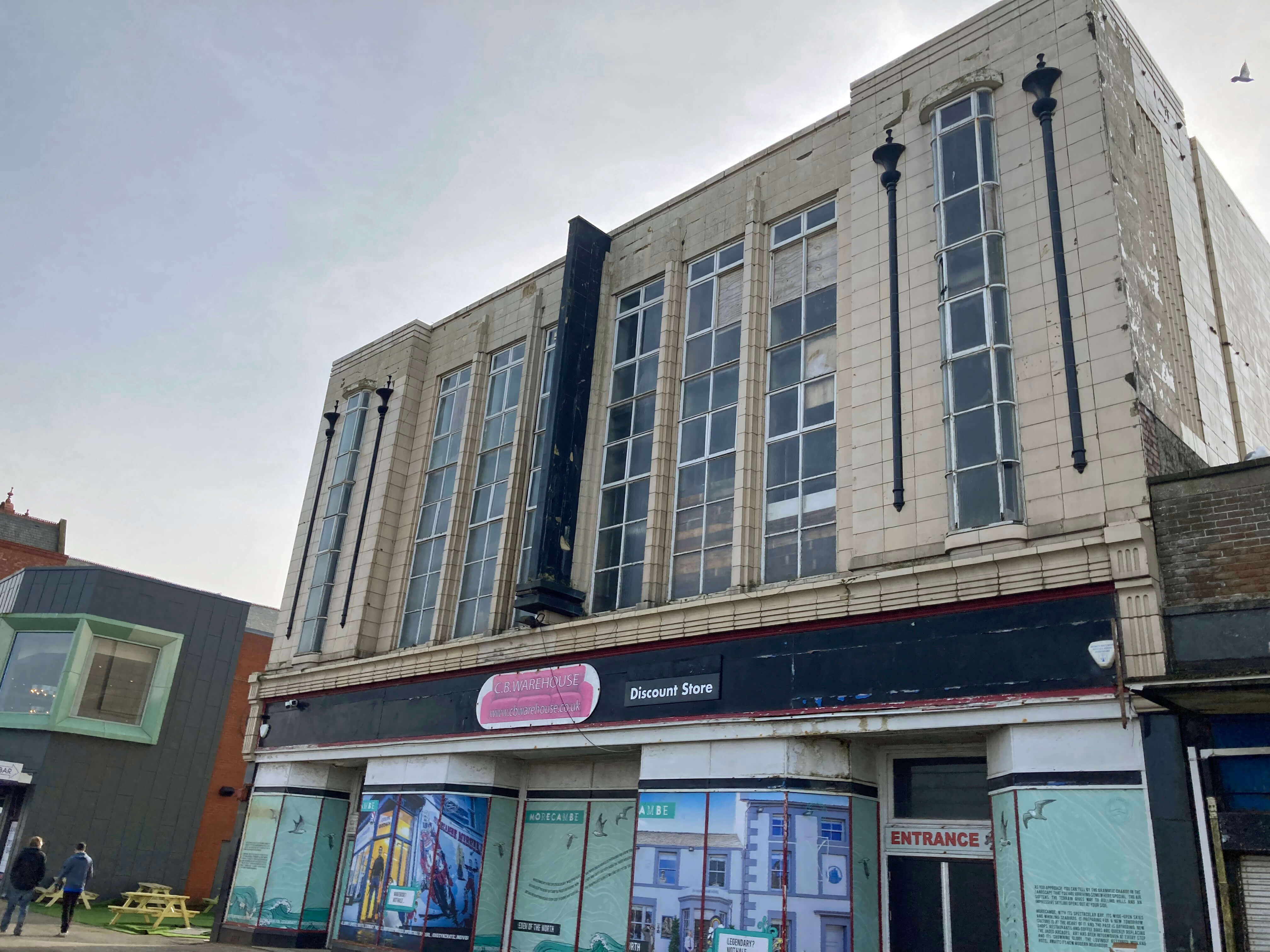
Left: (2) The old Woolworths Building; Right: (3) The old
Littlewoods Building.
Perhaps the essence of Art Deco lies more in the internal features, a key aspect
of the Midland Hotel (although I understand that many of them were replaced
in a 1970s refurbishment). In that case, I should study Brucciani’s Ice
Cream Parlour. I don’t know if an expert would immediately label Brucciani’s
as Art Deco from its external appearance. It has curved bay windows, horizontal
lines indicating (non-existent) balconies, like the Midland Hotel, on a much
smaller scale, and the windows look a bit like those of Littlewoods. Anyway,
Brucciani's is on the list because it retains Art Deco period features inside.
So I paused at Brucciani's for a coffee to inspect those internal features – but it
was shuttered up.
So far the Art Deco buildings have had smooth, bright walls. The next
building, the Bath Hotel in Northumberland Street, is different. Of course, what
we see today may well differ from the original building. This hotel was built
in the 1890s (which precedes the Art Deco period) and in 2024 "had an Art Deco
makeover". That's not fair! How can I make sense of Art Deco if people
come along a hundred years later and sprinkle an Art Deco pastiche everywhere? At
least it's good to know that Art Deco, whatever it is, is still considered stylish.
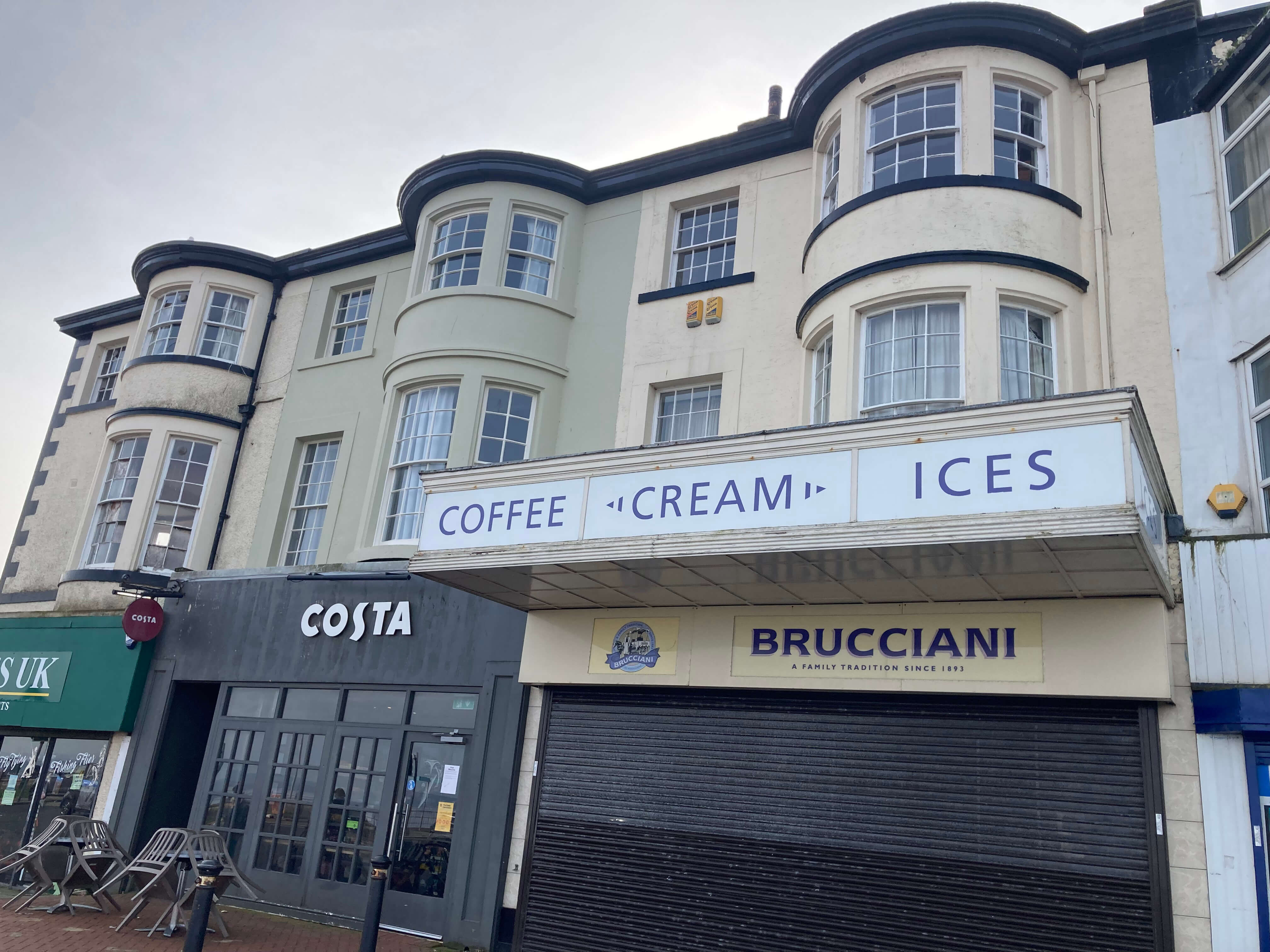
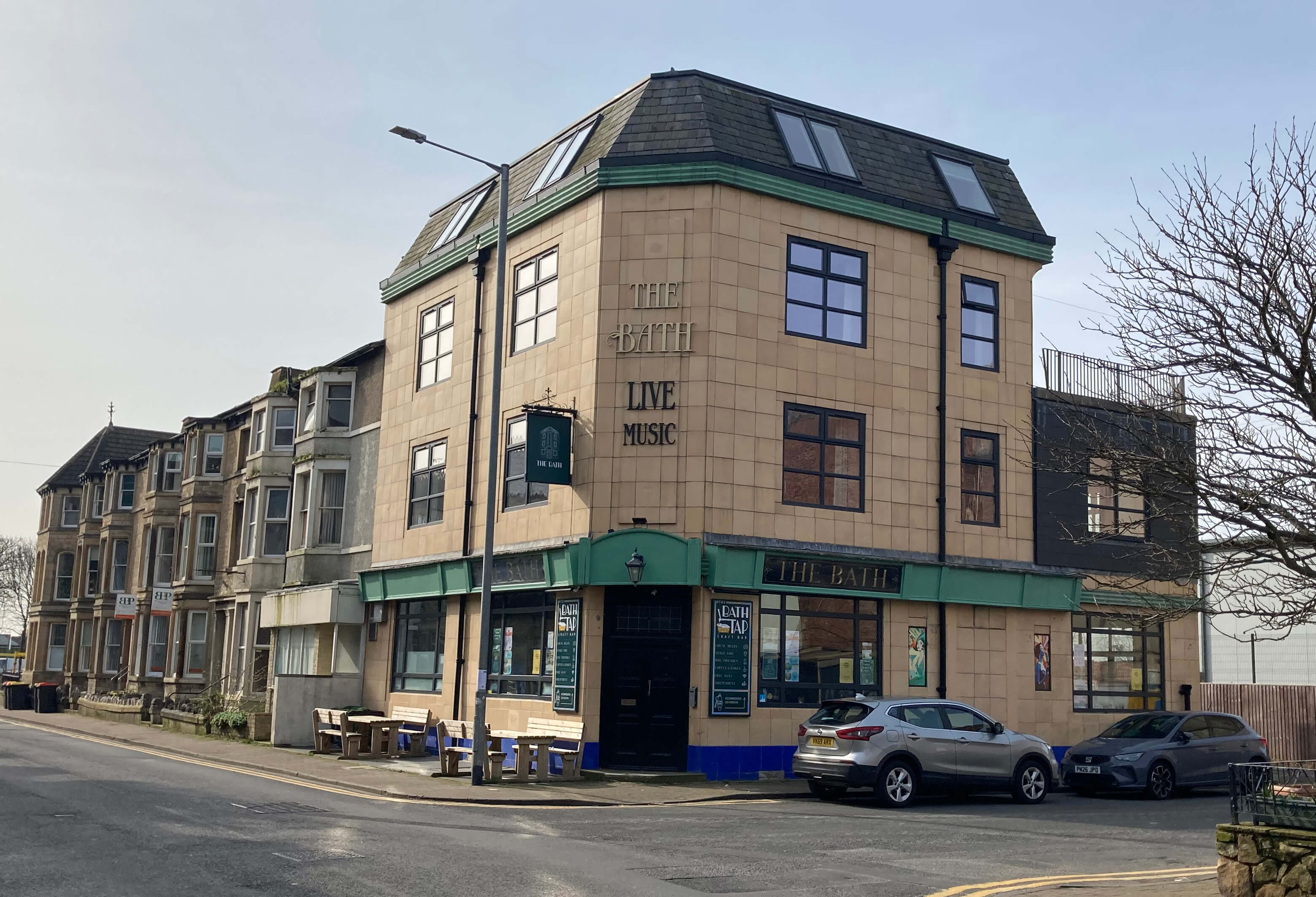
Left: (4) Brucciani's; Right: (5) Bath Hotel.
I continued eastwards to Back Crescent Street to see the ‘Bridge of Sighs'. If this
is an allusion to the Bridge of Sighs in Venice then someone has a fanciful imagination.
However, I understand that ‘bridge of sighs' is a general term used by architects
to refer to a bridge between buildings. While Morecambe's Bridge of Sighs is
certainly unusual for Morecambe it seems that it is not unusual enough to be given
any special care.
Next I walked on to Victoria Street to see the old Morecambe Visitor
office at number 12 (now called Brew Me Sunshine) and the old TSB office at the
corner with Market Street. Now the difficulties of identifying Art Deco-ness
from these examples becomes clearer. It is hard to tell how much the buildings
have been changed from the original. I can believe that the architects made an
effort to produce something out of the ordinary, but not that far out, it seems.
Today the buildings look little different from other non-Art Deco buildings (to me, anyway).
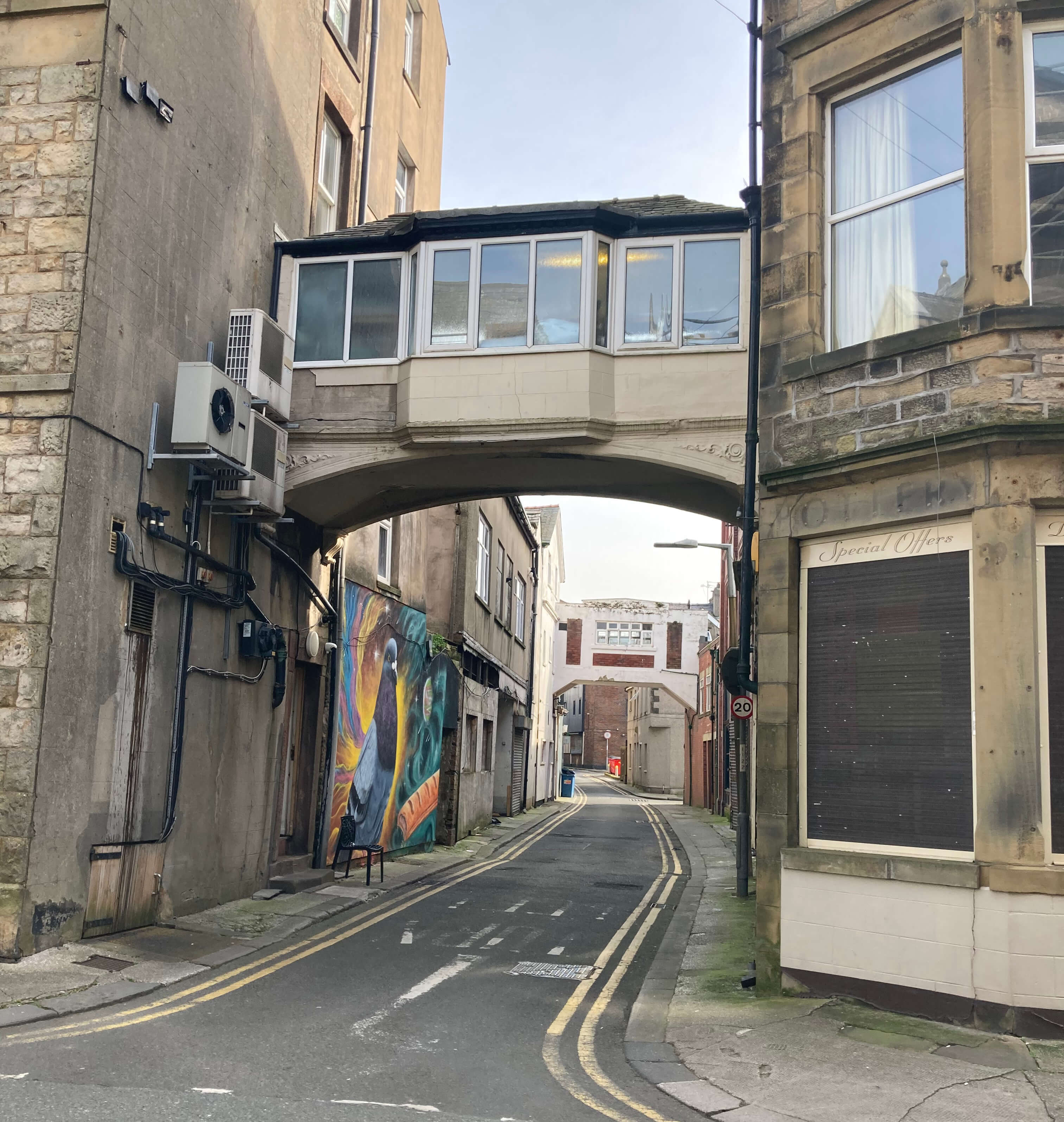


Left: (6) Morecambe's Bridge of Sighs; Middle: (7) old
Morecambe Visitor office; Right: (8) old TSB Office.
I returned to Marine Road Central to view four buildings that are among the listed
sixteen. The first (no 257) is what was until recently the Oasis Building (an
amusement arcade). I don't know what its original function was. Today it's
Treasure Island (on the ground floor). I suppose, with a bit of squinting, I might perceive some
similarity with the Littlewoods Building. Next (at no 262) is the old NW Bank.
This looked a sombre building to me. Dark columns and balustrades seemed alien to
the light airyness I had come to expect.
I felt that if this is Art Deco then almost anything is.
This opinion I felt confirmed by the next on the list (at no 267), which
is now the Clock Tower Casino. Is a bright white wall with windows all you
need to qualify as Art Deco? My despair at being unable to pin down the
nature of Art Deco was deepened by the next on the list – the Clock Tower Café plus
toilet block. Is whoever created this list of sixteen having a laugh saying
that this is Art Deco? Art Deco is short for Arts décoratifs. I studied the
block, from all angles, and saw nothing décoratif about it. I couldn't inspect
the inside, as the café was closed and I wasn't going to pay for the toilets
(there is a limit to my dedication). It looked like the block may have been
built in about 1930 but it surely takes more than that to qualify as Art Deco.

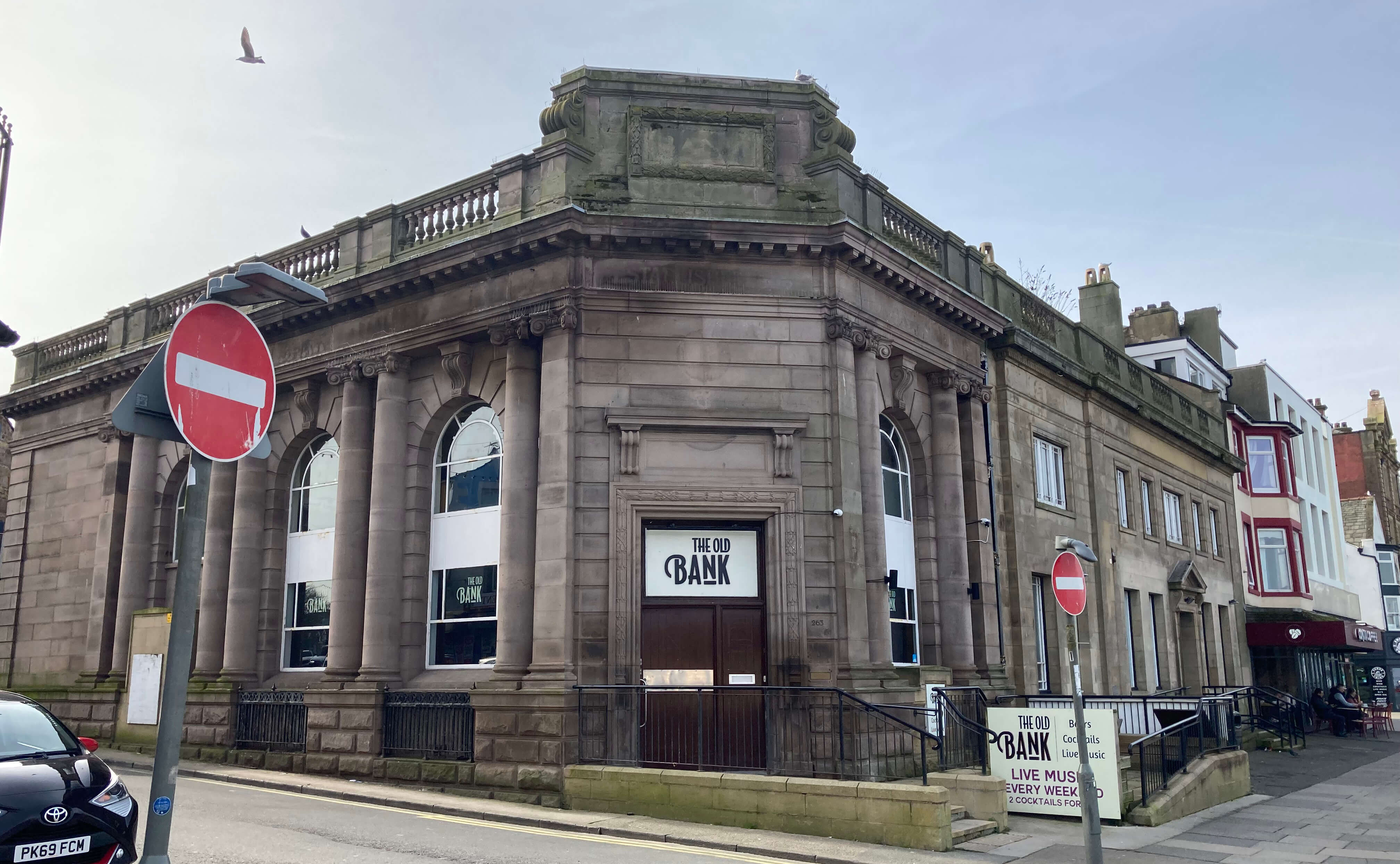
Left: (9) old Oasis Building; Right: (10) old NW Bank.


Left: (11) Clock Tower Casino; Right: (12) Clock Tower Café.
Next on the list is 23 Clark Street, which was Tyson's Antiques and previously a
garage but is now unused. It is hard to picture it in its Art Deco glory, if it
ever had any. I needed a break so I strolled along the prom for a while, with
hazy views over a full Morecambe Bay to Grange-over-Sands but not beyond. I then
walked along a residential Thornton Road to Hodgson's Garage at (about) no 115.
I liked the Morris Minor parked outside! But I'll clearly have to rethink my
image of garages. In the 1930s garages must have not been the work-a-day places
they are today but buildings of panache and elegance, as no doubt expected by
the few (and wealthy) car-owners.


Left: (13) ex-Tyson's Antiques; Right: (14) Hodgson's Garage.
I walked on to the old Odeon Cinema in Euston Road. This is more like it! I imagine
that many cinemas of the period were built in an Art Deco style in order to generate
a sense of glamour and extravagance. Here we can surely see similarities with the
Midland Hotel, with the graceful curves, plain walls (some bright), horizontal lines
and flat roof (best seen in the 1937 photo below, without the recent additions). It
looked like a beached ocean liner. I understand that this cinema looked very
similar to Scarborough's Odeon Cinema, which is now the Stephen Joseph Theatre.
Morecambe's Odeon,
which closed in 1976, is no doubt beyond recovery. I wandered inside Homemakers
to see if there were any signs of the building's previous life. I noticed a curved
green structure in the ceiling that could have been part of a balcony but really
the place looked little different to any other warehouse-cum-shop.


(15) The old Odeon Cinema, now (left) and in 1937 (right).
Finally on the list of sixteen I was directed to 126 Lancaster Road, which is now
the County Car Wash. It was quite a way to walk for such an unprepossessing
building, with nothing décoratif that I could see. I had trusted that whoever had
bothered to create the list of sixteen knew enough to identify these buildings as
Art Deco. However, I really cannot see anything special about some of them,
although, of course, any original Art Deco features may well have been lost in the last
one hundred years. It is dispiriting to see that most of these buildings are now
disused or misused, without whatever Art Deco-ness they once had – but that perhaps is
all part of the history of Morecambe.
The term ‘Art Deco' does not appear in the index of the 300-page Bingham (1990)
history of Morecambe. There seems to be some desperation to pretend now that Art
Deco played a significant role in Morecambe's past. In general, the further I walked
from the Midland Hotel then (with the exception of the old Odeon Cinema) the more
any Art Deco-ness seemed to fade away. I'll assume that the Midlands Hotel, the
Woolworths Building and the Odeon Cinema (as it was) best capture the essence of
Art Deco.


Left: (16) County Car Wash; Right: (1) Midland Hotel, bay-side.
I returned to the promenade and walked briskly back to the Midland Hotel (the
Clock Tower Café and Brucciani's were still closed). All the other fifteen
buildings were to the east of the Midland Hotel. Are there any Art Deco
buildings to the west? The West End of Morecambe was developed in the late
19th century, so I don't see why not. So, needing a more energetic walk,
I set off west to see if, with my new-found expertise (I wish), I could
spot any Art Deco.
Of course, there were no ah-Art Deco! moments but it wasn't entirely my fault.
For much of the way there are no buildings to assess, since, rather shamefully,
for twenty years no use has been made of the prime seaside site of the old Frontierland.
Then further on, all the buildings are virtually the same – three-to-five storey (depending
whether you count loft extensions and basements) bay-windowed guest houses. I rather
liked the mirror-image buildings at the bottom of West End Road. Further on, the
frontage is dominated by the old Alhambra Palace, built in 1901 opposite the old West
End pier (demolished in the 1970s). It is a brute of a building, huge, cuboid and dark.
I understand that the Morecambe Alhambra Theatre Trust contrives to keep this building
alive but I cannot imagine what use can be made of such a vast space. Anyway, it is not Art Deco.


Left: West End Road; Right: the old Alhambra Palace.
Perhaps, in a hundred years time, someone will walk around Morecambe to study the remains of its Art Amuso of the 2020s:

Date: March 21st 2026
Start: SD433642, bus stop at Morecambe railway station (Map: 296)
Route: W on Central Drive, NE, E on Marine Rd Central,
S on Northumberland St, E, NE on Victoria St, N on Skipton St, E on Back Crescent St,
S on Graham St, E on Victoria St, N, NE on Marine Rd Central, SE on Green St,
NE on Clark St, N on Lord St, NE, E on Marine Rd East, S, W, S on Thornton Rd,
SE on Lancaster Rd – County Car Wash – NW on Lancaster Rd, W on Euston Rd,
NW on Queen St, SW on Marine Rd Central, SW on Marine Rd West – The Battery –
NE on Marine Rd West, E on Central Drive – bus stop
Distance: 6 miles; Ascent: 5 metres
Home
Preamble
Index
Areas
Dales
Hills
Lakes
Places
Reserves
Rivers
Structures
Villages
References
Me
© John Self, 2018-

Top photo: Rainbow over Kisdon in Swaledale;
Bottom photo: Ullswater