
Home
Preamble
Index
Areas
Dales
Hills
Lakes
Places
Reserves
Rivers
Structures
Villages
References
Me
Saunterings: Walking in North-West England
Saunterings is a set of reflections based upon walks around the counties of Cumbria, Lancashire and
North Yorkshire in North-West England
(as defined in the Preamble).
Here is a list of all Saunterings so far.
Guaranteed ad-free, AI-free and free!
261. Re-Industrialising the Lune Valley
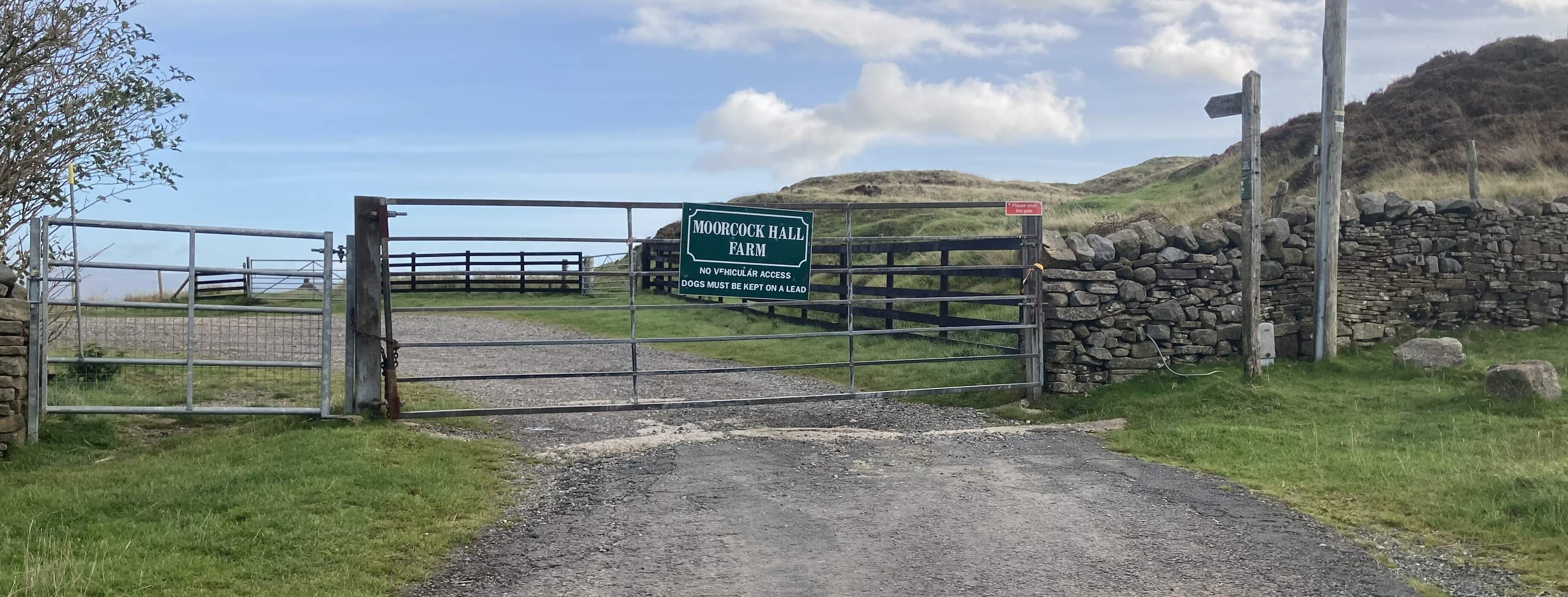 First, a little puzzle. Once, some time ago, I arrived at the gate
shown right, which is at the top of Quarry Lane two miles up from my
home village, to find two walkers struggling to work out which way
to go. They had a booklet giving directions but they couldn’t
relate them to the surrounding terrain. After determining their
objective (the Fenwick Arms in Claughton) it was easy to advise
them – but why had they been unable to make sense of their booklet’s
directions? Any ideas?
The walk up Quarry Road is usually without incident but
today I wish it were. Something landed in my hair and as I brushed
it off it stung me. I’ve been stung before but not,
I think, with this much venom. I extracted the sting from my finger
but it was extraordinarily painful. I nearly returned home for some
sympathy but I bravely soldiered on.
On that earlier occasion I studied the walkers’ booklet and,
yes, the directions therein made no sense. They were at the bottom
of a left-hand page, continuing onto the right-hand page (a clue!).
Then I noticed that the left page was numbered (I don’t remember the
actual number but let’s say) 40 and the right page 45. The middle
sheet of their booklet (pages 41-44) was missing. By a fluke the
text of page 40 flowed smoothly into that of page 45. Relieved that
they were not as incompetent as it appeared, the walkers continued
on their way.
With my finger throbbing excitedly, I followed their route
and walked past the renovated Moorcock Hall. I had intended to leave
the track on the first field thereafter to walk over to the wall to
peer over it to watch the activities in the brickworks quarry, as we
always used to do. However, there were frisky bullocks in the field
and I saw no point in provoking them as it was obvious from the silence
that there was no activity in the quarry.


Left: The view over the Lune valley towards the Lakes from the
path to Moorcock Hall; Right: Moorcock Hall, Whernside and Ingleborough to its left.
This morning I heard a minister telling us that the government
planned to ‘re-industrialise Britain’. It is natural to wonder how
this might affect one’s own locality, say, the Lune valley from Tebay
by Sedbergh and Kirkby Lonsdale to Lancaster. To assess this, it
might help to consider the extent to which the Lune valley was
industrialised in the past.
There were mills in almost every town and village, producing at
various times goods such as silk, cotton, linen, flax, bobbins, pottery
and even fire-hoses. They had all closed down by fifty years ago and
have been demolished or converted into residences. There is no prospect
of re-industrialising them. There was some coal-mining and stone
quarrying but on a small scale and it seems very unlikely that they will
be revived. There were also several niche activities that
were hardly heavy industry but did provide employment, producing
baskets, clogs, hats, nails, socks, and so on. Many were carried on
within residences and passed on as family concerns.
And then there was the Claughton Brickworks, the only place in
the valley still with a traditional tall chimney belching smoke (until
recently). It had continued for over a hundred years up to the present
decade. There was a
report
in 2023 saying that the owners were mothballing the brickworks because
of a lack of demand for the bricks. It had previously been mothballed
in 2010, after the 2008 economic crisis, but it had then soon re-opened.
Will it re-open this time? I don’t see the same reasons
for a temporary closure as in 2010. In fact, with the government’s
desire to build many new houses I would have thought the demand for
bricks would be buoyant. Are bricks for house-building less popular
nowadays? It does seem (to a layman such as me) that building
with bricks is slow, labour-intensive and probably costly compared to
other modern building methods. On our guided tour of the brickworks
some twenty years ago, it was obvious that the huge kilns use great
amounts of energy. They also release carbon dioxide. Perhaps new
net-zero standards are an issue?

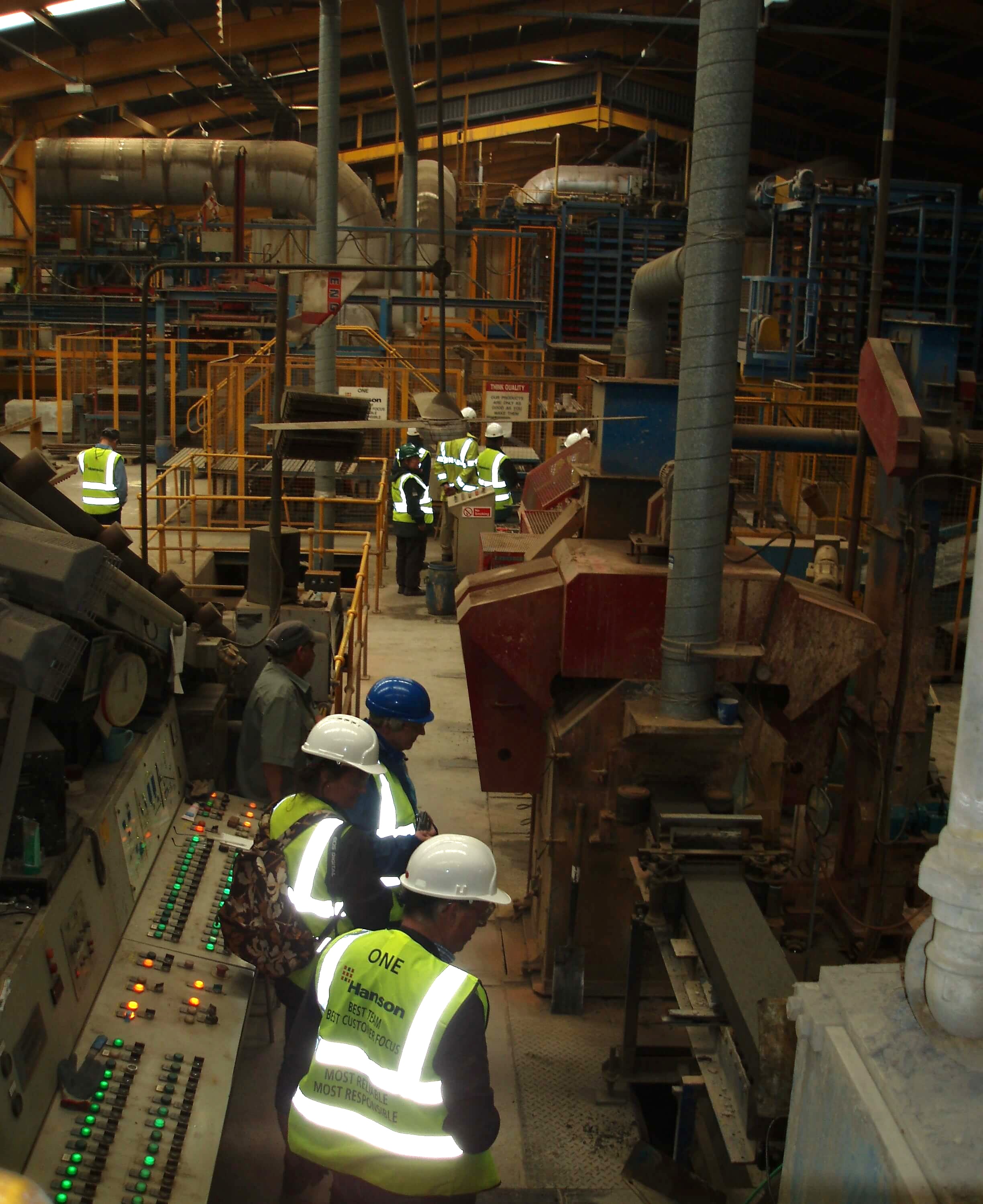
Inside the Claughton Brickworks (about twenty years ago)
When an activity such as the Claughton Brickworks ends it doesn’t
do so with a fanfare. It stops ‘temporarily’, and then the stop
extends, and eventually it just becomes uneconomic to ever re-open.
I suspect that we will never again see the buckets of shale
crossing over the A683, on what was said to be the last such aerial
ropeway in the country. As always, there would be mixed feelings
about this. It would be a pity for a historic activity to end and,
of course, a shame that fifty or so people would lose their jobs.
On the other hand, nobody would be pleased to see Claughton Moor
disappear, with a rather hideous quarry left in its place. If the quarry were
abandoned then it could instead soon become a nature reserve,
with a bit of help from us.
So, if the Lune valley is to be re-industrialised then it
will have to be with new industries. I await the government’s
proposals with interest. Many of the present residents are here
precisely because there is little industry. If they are not retired
then they are content to commute in order to live in a rural setting
or they are engaged in the numerous services (estate agents,
gardeners, plumbers, schoolteachers, shopkeepers, and so on) that
keep a community ticking over. New heavy industry would hardly be
welcomed by them.


The path down from the brickworks quarry
With my finger now twice the size it was, I walked on down the track
past the gate for the quarry, with a large ‘private’ sign which I
was not tempted to ignore. The track was composed of loose brick rubble and was
no pleasure to walk upon. Eventually I passed the inscrutable Claughton
Hall and crossed the A683 to walk on to the flat Lune floodplain, with
open views along the valley. It was silent and soothing. The only
moment of angst was when a little egret and a heron had a
contretemps – or at least a loud debate about something or other.

Where Claughton Beck joins the River Lune
My finger now has a rosy glow, almost pleasant, but sore. I think I’ll pull through.
Date: September 28th 2026
Start: SD543644, Brookhouse (Map: OL41)
Route: E on Quarry Road – picnic spot, Moorcock
Hall – N – Claughton Hall, Claughton – N by Claughton Beck – River
Lune – SW on south bank of the Lune – Bull Beck Bridge – S – Brookhouse
Distance: 8 miles; Ascent: 245 metres
964 +458 /2400
Home
Preamble
Index
Areas
Dales
Hills
Lakes
Places
Reserves
Rivers
Structures
Villages
References
Me
© John Self, 2018-
Contact: johnselfdrakkar@gmail.com

Top photo: Rainbow over Kisdon in Swaledale;
Bottom photo: Ullswater