
Home
Preamble
Index
Areas
Dales
Hills
Lakes
Places
Reserves
Rivers
Structures
Villages
References
Me
Saunterings: Walking in North-West England
Saunterings is a set of reflections based upon walks around the counties of Cumbria, Lancashire and
North Yorkshire in North-West England
(as defined in the Preamble).
Here is a list of all Saunterings so far.
If you'd like to give a comment, correction or update (all are very welcome) or to
be notified by email when a new item is posted - please send an email to johnselfdrakkar@gmail.com.
231. On the Wasdale Explorer
Everybody knows that there are too many cars in the Lake District, especially on a
sunny summer Saturday. Nobody knows what should or could be done about this.
We noticed that there was a free weekend shuttle bus service (The Wasdale
Explorer) between Ravenglass and Wasdale Head that aims to reduce the number of
cars that are driven there. Since we hadn’t been to Wasdale for some years, we
thought we’d support this worthy endeavour, to see what difference it made or could make.
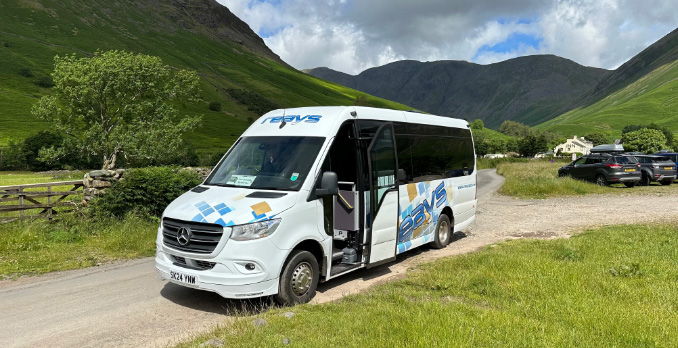 The bus (minibus, really, shown right (the leaflet photo)) could carry 25 passengers
(22 seated) but on our trip I counted only 14,
and some of them hopped on and off at intermediate stops. I think only half-a-dozen
got off at Wasdale Head. So that’s a saving of about three cars (which assumes that
without the bus those half-a-dozen would have travelled by car: we wouldn't have).
The bus (minibus, really, shown right (the leaflet photo)) could carry 25 passengers
(22 seated) but on our trip I counted only 14,
and some of them hopped on and off at intermediate stops. I think only half-a-dozen
got off at Wasdale Head. So that’s a saving of about three cars (which assumes that
without the bus those half-a-dozen would have travelled by car: we wouldn't have).
 As it was indeed a sunny summer Saturday, we passed hundreds, possibly
thousands, of parked cars in Wasdale. They were
squeezed into every available space – and some unavailable ones too, such as passing
places. At Greendale, by Wastwater, innumerable cars had brought people
to sunbathe, picnic, paddle, swim, kayak and paddle-board by, in and on the lake. If you
ignored Wasdale Screes opposite then you might imagine yourself on, say, Scarborough
beach. Here, though, there are no waves knocking you over, no rips to worry about,
no tides making you move your sunbed, no stinging jellyfish. I didn’t notice an
ice-cream van but there may well have been one.
What more could be desired? Toilets, perhaps.
As it was indeed a sunny summer Saturday, we passed hundreds, possibly
thousands, of parked cars in Wasdale. They were
squeezed into every available space – and some unavailable ones too, such as passing
places. At Greendale, by Wastwater, innumerable cars had brought people
to sunbathe, picnic, paddle, swim, kayak and paddle-board by, in and on the lake. If you
ignored Wasdale Screes opposite then you might imagine yourself on, say, Scarborough
beach. Here, though, there are no waves knocking you over, no rips to worry about,
no tides making you move your sunbed, no stinging jellyfish. I didn’t notice an
ice-cream van but there may well have been one.
What more could be desired? Toilets, perhaps.
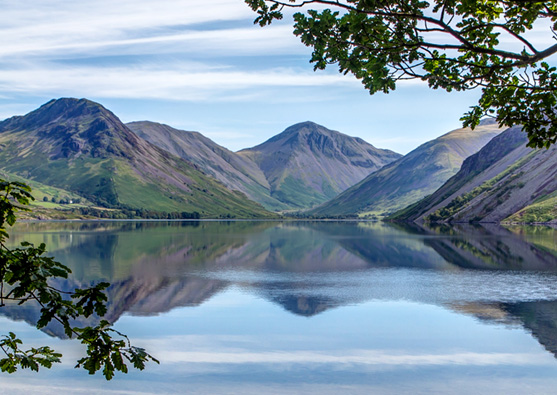
The view from Greendale up Wastwater is often voted the best in England.
It features on the Explorer’s leaflet, with no people visible (as shown left). I wonder if those
here really appreciated the view. Would they have been just as happy at some
other lake? I would have liked to have taken a photo of all the
cars and people (plus view) but
of course I couldn’t get off the bus. One reason that people will not give up
their cars and take to the bus is that they value their autonomy, their freedom
to adapt their journey as they wish.
For a bus passenger it is a relatively relaxing journey. You can
let the bus driver worry about negotiating the lanes which are wide enough for only
one vehicle, or two at passing places (if empty). When it’s busy, as it was,
considerable manoeuvring is necessary. Ironically, for us the most difficult
was when two buses needed to pass one another. Any emergency service would not
have been able to hurry along this lane.
We were eventually deposited at the Wasdale Head car park, which was, of
course, over full, and left to wander about as we wished until the return bus. It
was, however, much too hot (over 30 degrees) to do much wandering about. Great Gable
and the other fells looked their usual magnificent selves but it was out of the question
to walk up there.
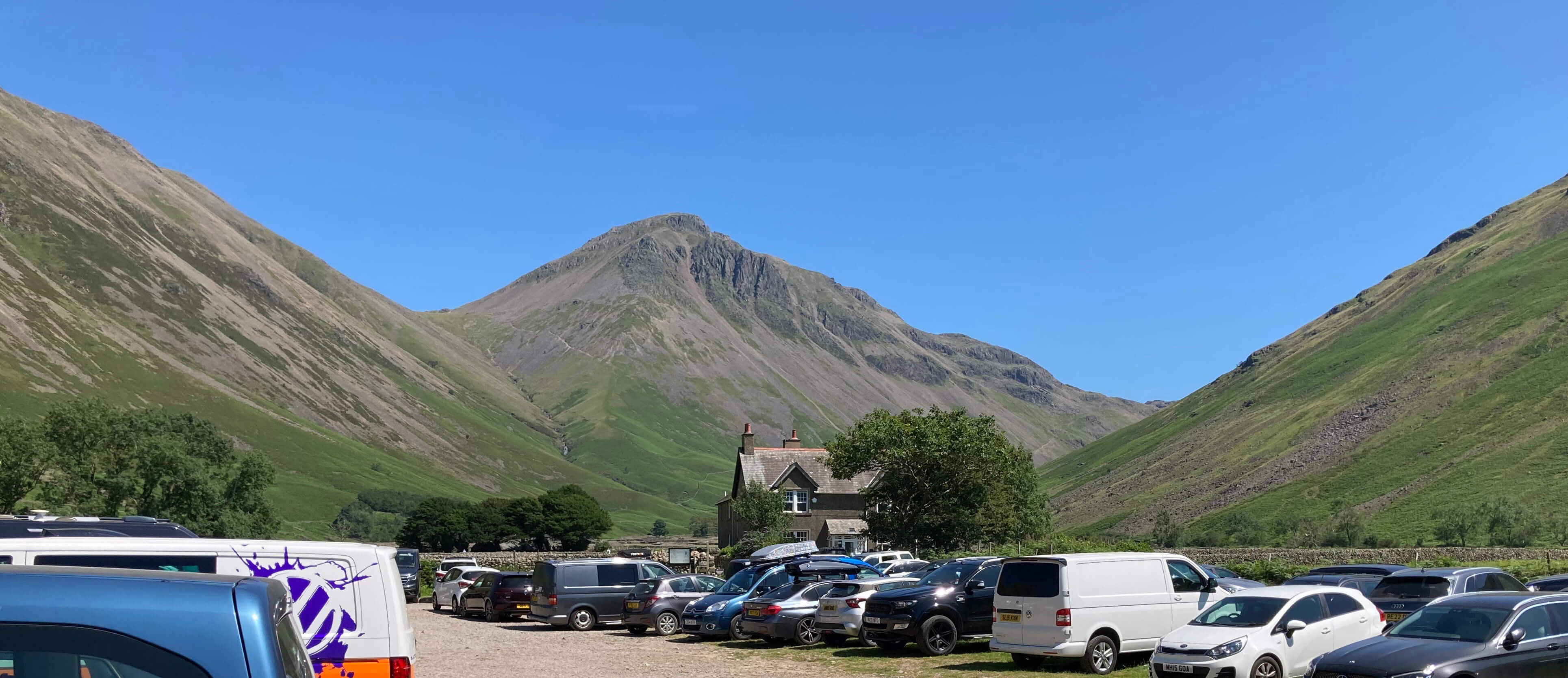
Great Gable from the Wasdale Head car park
Actually, even on a good walking day, one of the problems with travelling by bus
is that you have to ensure that you are back in time for the return bus. Can you
guarantee to walk up Great Gable and back in five hours? You'd have to walk with one eye on
the time, which is not the best frame of mind for fell-walking. You don’t want to
end up running for the bus. So you allow plenty of time – and then have to hang
around at the bus stop. There is also a worry that the bus will be full. If 75
people travel here on three buses in the morning and then aim for the last bus back,
as they normally would, how does that work?
We didn’t have this concern today. After an ice-cream we strolled to the
famous Wasdale packhorse bridge over Mosedale Beck in which a woman the size of a whale and her family
were disporting themselves. Not a pretty sight, although the bridge alone is.
Another woman advised us how to keep cool – fill your hat with water before putting
it on your head.
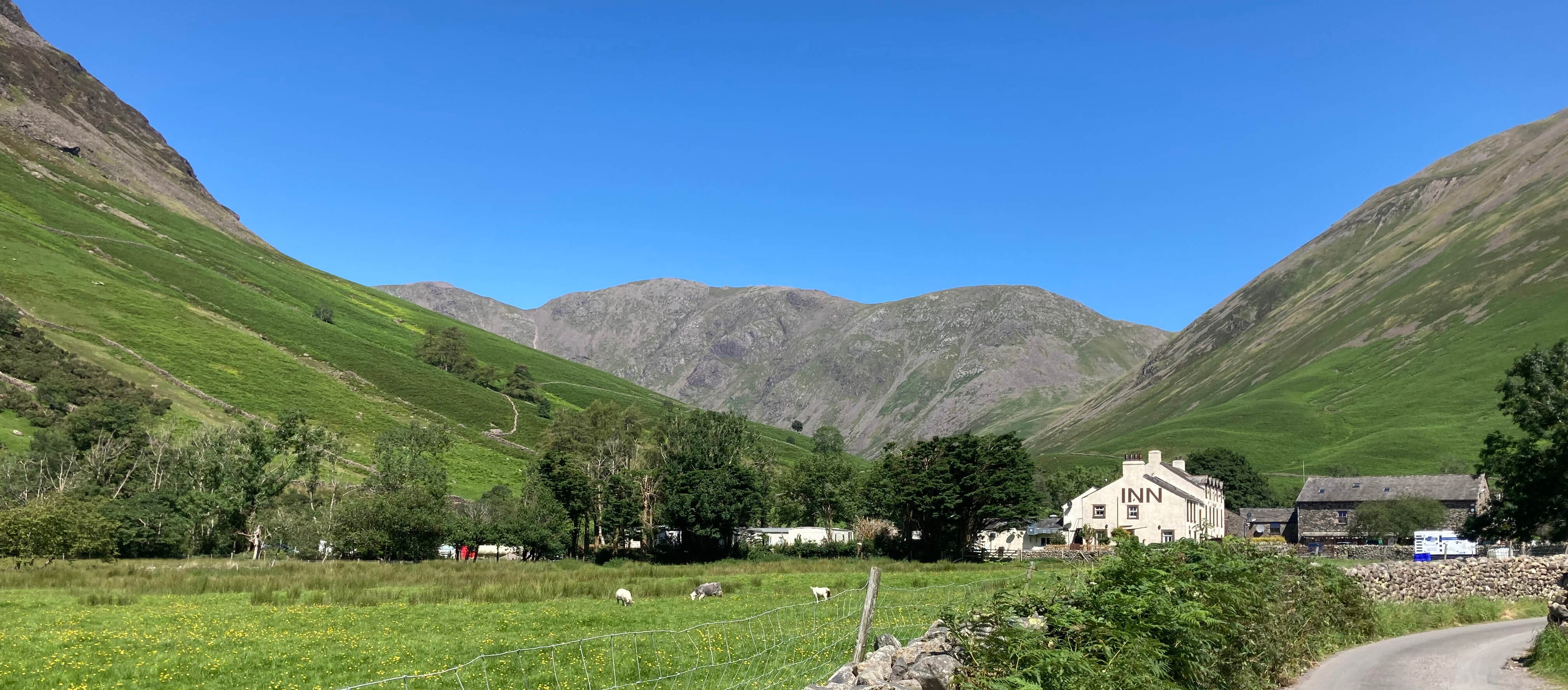
Walking towards the Wasdale Head Inn
After a few minutes we couldn’t contemplate milling about for hours in this heat with all
these people similarly milling about. So we decided not to wait for the late bus
but headed back for the next one. Perhaps we set a record for the shortest visit to
Wasdale Head, just one hour – equalled by another woman on the bus who had the same
thought.
The shuttle bus project may be commendable but I am sorry to say that I
don’t think it is a step towards a solution. It reduces the number of cars by only
a tiny fraction at best. As it is, the buses themselves increase congestion in the lanes.
It is hardly possible to have more buses – unless we are bolder, by, for example,
having a park-and-ride scheme, with a huge car-park at, say, Nether Wasdale and
allow only shuttle buses up and down the valley.
Perhaps shuttle boats would be better than shuttle buses.
If we are prepared to accept the loss of the serenity of Wastwater (as we seem to have with so many people on
and in it) then perhaps we could adopt the lake as a highway. A fleet
of shuttle boats could transport thousands of people up and down the lake.
Windermere, Ullswater, Coniston Water and Derwent Water already have boats but they are mainly
for pleasure trips. I picture a more purposeful Wastwater shuttle – from one end of the lake to the other.
However, there is a plan
to ban all power-driven vessels from the Lake District's non-navigable small waters,
which apparently includes Wastwater.
Is Wastwater really non-navigable and small?
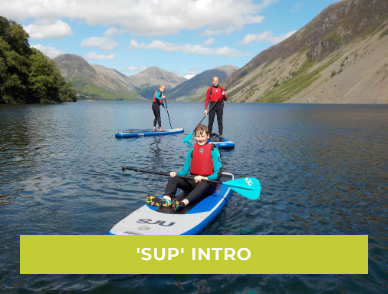 Left: West Lakes Adventure offers a SUP Intro course (£55 per person, I think) –
SUP being Stand Up Paddle-boarding, of course.
Left: West Lakes Adventure offers a SUP Intro course (£55 per person, I think) –
SUP being Stand Up Paddle-boarding, of course.
The Wasdale Explorer is free (at the moment) for users but it is, of course, not free to
run. The buses and the drivers cost money. The leaflet mentions a number of
bodies involved in providing this service – the Wasdale Action Group, the Lake
District National Park Authority, the Strategic Visitor Management Group, the
National Trust and Cumberland Council. No doubt they will all be reviewing this
service. It will be interesting to see what they conclude.
One of the difficulties in converting people from cars to buses is that it
takes an effort of will to find out information about the latter. Lake District
buses seem to me to be somewhat piecemeal, perhaps experimental, unintegrated and
of uncertain reliability. It is much easier to just hop in the car.
Transport apparently accounts for nearly half of the Lake District’s carbon
emissions. Its goal of net zero by 2037 can hardly be achieved with all these cars.
I would need some detailed arithmetic to convince me that buses will help. Our
share of our bus’s emissions is probably greater than it would have been of our
electric car.
But what is the problem anyway? People come here of their own free will.
They surely know what to expect. If they don’t like all the crowds then they won’t
come again. If they do they will. And so a happy equilibrium will be reached.
They may not be doing what I would like to do in Wasdale but so what? I’d like to
experience a sense of tranquillity and escape in Wasdale – but clearly many people don’t.
Wasdale has not made any special effort to attract people here. Wasdale is
essentially just Wasdale, as it always was. There are no houses or farmsteads along
the length of Wastwater to be inconvenienced by the cars and the crowds. The owners
of the Wasdale Head Inn are presumably happy to have so many potential customers nearby.
 The situation is different in neighbouring Eskdale. Eskdale too has narrow lanes but also many
farms and residences. Our few days there coincided with Eskfest 25, a mini-Glastonbury,
I assume. The fields around the Woolpack Inn were crowded with cars and campers.
The noise (music, I suppose) of the event could be heard up Harter Fell. So, all these
cars had been lured here, some of them no doubt coming, unsuspectingly, over the
Wrynose and Hardknott Passes.
The situation is different in neighbouring Eskdale. Eskdale too has narrow lanes but also many
farms and residences. Our few days there coincided with Eskfest 25, a mini-Glastonbury,
I assume. The fields around the Woolpack Inn were crowded with cars and campers.
The noise (music, I suppose) of the event could be heard up Harter Fell. So, all these
cars had been lured here, some of them no doubt coming, unsuspectingly, over the
Wrynose and Hardknott Passes.
I may be curmudgeonly to ask but why do people come to such an event in
Eskdale? Does Eskdale itself appeal to them? Or could the event be anywhere? The
event seems out of keeping with the otherwise quiet, rural ambience. But again no
doubt the owners of the Woolpack Inn are pleased to squeeze as many cars here as they
can. I cannot fully sympathise with those locals who complain about all the cars
cluttering their lanes when other locals are dreaming up all sorts of ways to
attract even more cars.
I sometimes wonder if the imminent (they have been imminent for a while)
driverless cars will help. I fear they will make matters worse. We won’t need to
own cars but we will just summon one when needed. So if we fancy a trip to Wasdale
we’ll call a car and relax while it battles through all the other driverless cars.
If the car can’t park itself in Wasdale then it can drive itself off to park
somewhere else. Then, later, we can summon another one. It will be great ‘fun’
seeing how driverless cars cope with these lanes.
So we took the early bus back to Ravenglass and had another pleasant
stroll along its estuary front. The tide was at the highest we’d seen. Pleasant
though it was, I can’t but feel that there is something wrong if, with all
respect to Ravenglass, we preferred a walk here to one within the magnificent
scenery of Wasdale.
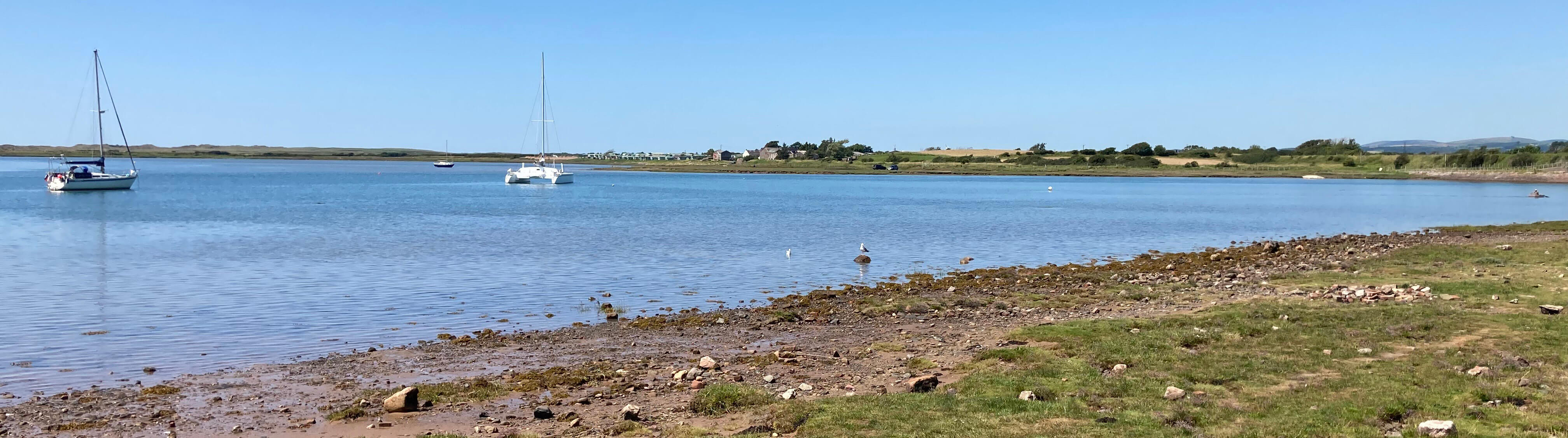
Esk estuary at Ravenglass
Date: July 12th 2025
Start: NY187086, Wasdale Head car park (Map: OL6)
Route: N for a bit – nowhere in particular – S for a bit – car park
Distance: 1 mile (or less); Ascent: 5 metres
Home
Preamble
Index
Areas
Dales
Hills
Lakes
Places
Reserves
Rivers
Structures
Villages
References
Me
© John Self, 2018-

Top photo: Rainbow over Kisdon in Swaledale;
Bottom photo: Ullswater